PropTech · Energy monitoring
Meter Minder
Energy monitoring for apartment buildings: every smart meter and inverter in one dashboard, anomalies flagged, readings submitted automatically.
- Status
- Live
- Year
- 2026
- What we delivered
- IoT cloud integrations · Energy analytics · Web dashboard · Accounting system integration · Deployment & backups
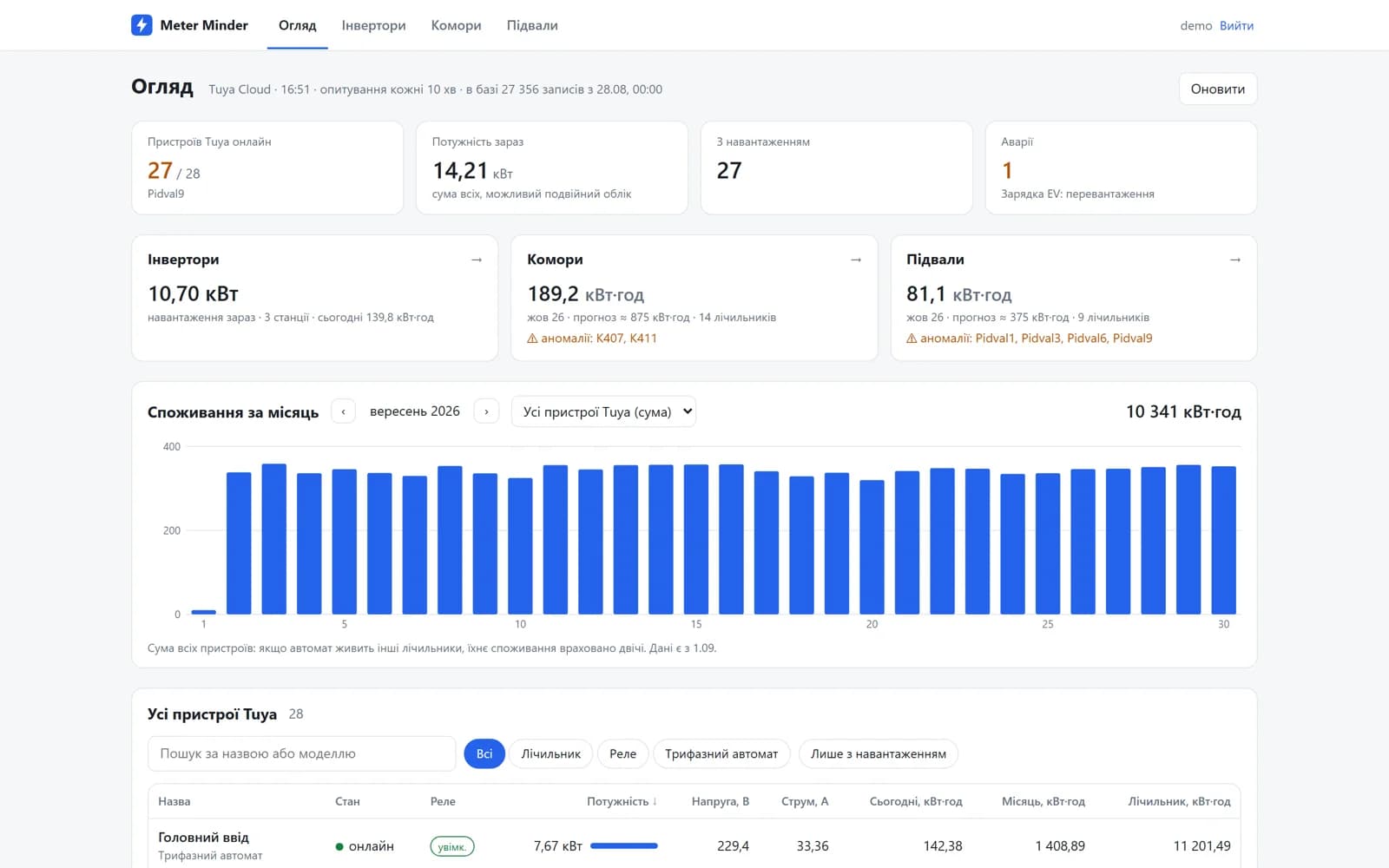
- smart devices in one dashboard
- 41
- smart devices in one dashboard
- anomaly rules with plain-language explanations
- 4
- anomaly rules with plain-language explanations
- readings to copy by hand at month end
- 0
- readings to copy by hand at month end
The challenge
Homeowners' associations install smart meters on storage rooms, basements, pumps, lifts and EV chargers, and solar inverters with batteries — but the data stays scattered across vendor apps. Nobody notices a storage room that suddenly draws five times its usual load, or a heater left running every night, until the bill arrives.
At the end of every month someone still copies dozens of readings by hand into the association's accounting system. It is slow, error-prone, and a missed deadline pushes charges into the wrong period.
The solution
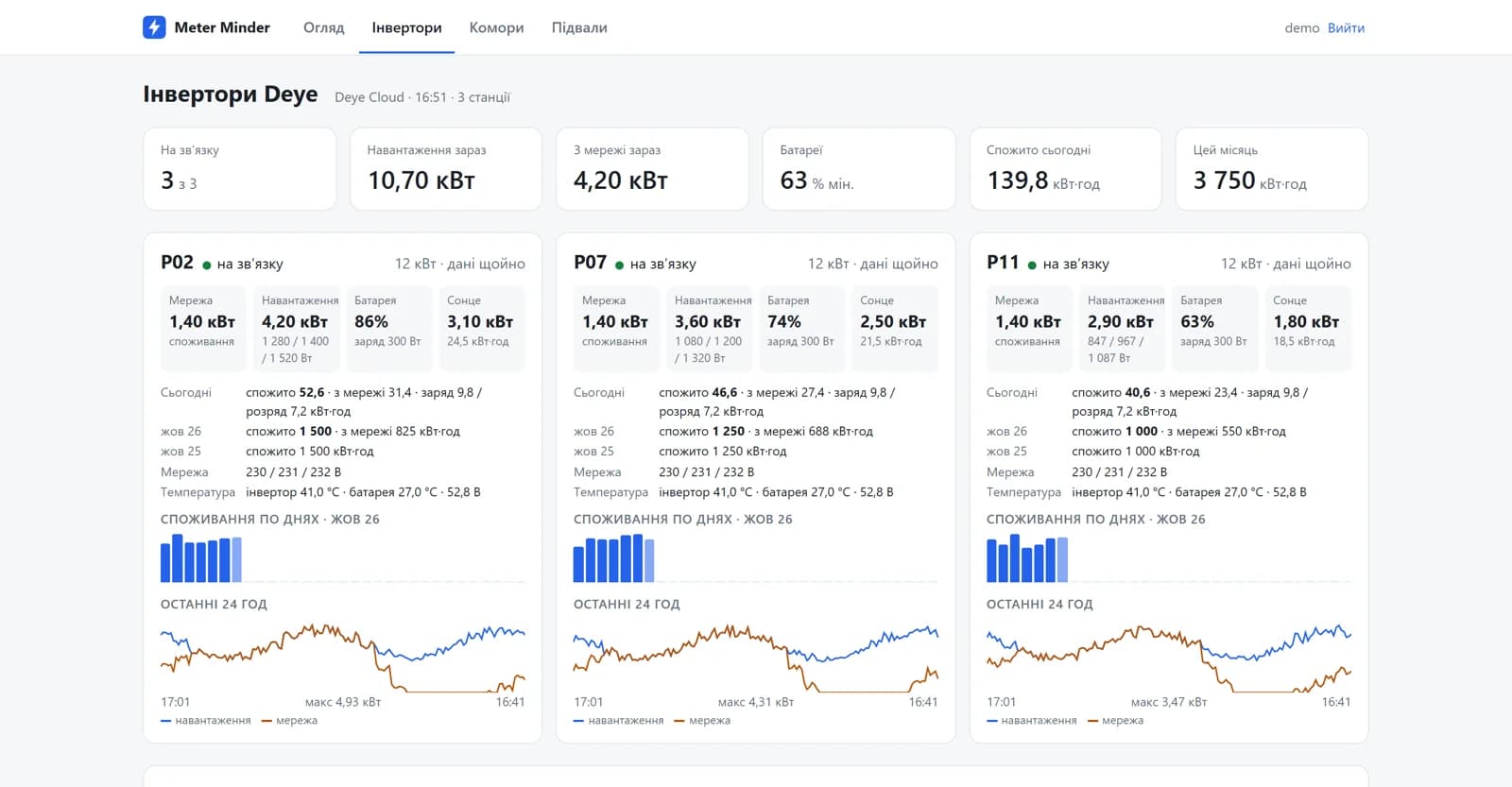
Meter Minder pulls everything into one place. Every ten minutes it polls the Tuya cloud for all smart meters and relays and the Deye cloud for the inverters, stores the history, and shows it on clean web pages: what is online and drawing power right now, consumption by day and month, inverter load, grid, battery and solar per phase, and a monthly forecast for every group of meters.
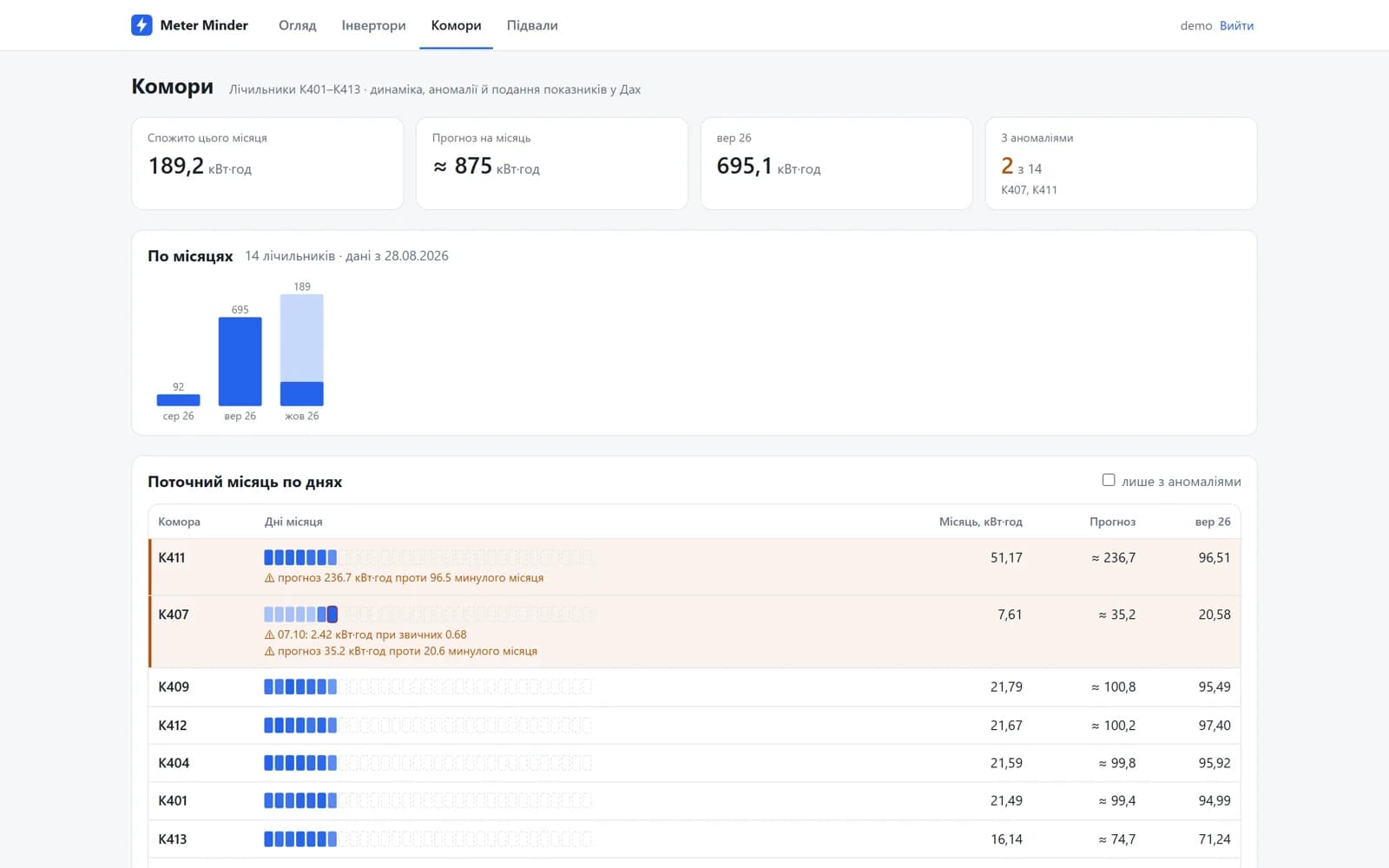
An analytics layer checks each meter against its own history and its peers: one-day spikes, constant night-time load, month-over-month growth and outliers in the group are flagged with a plain-language explanation. On the last day of the month the system calculates every storage-room reading and submits it to the accounting platform on its own — rounded down, never below the previous reading, and skipped when part of the energy is only an estimate.
Energy is counted carefully: devices with their own counter use exact deltas, relays use the kilowatt-hours they report, and gaps of up to a week are back-filled from the vendor's logs, so history survives restarts and device renames.
Key capabilities
- 01
One dashboard for everything
Smart meters, relays and solar inverters from different vendors' clouds, with live power, faults and daily totals.
- 02
Anomaly detection
Daily spikes, night-time load, month-over-month growth and group outliers — flagged before the bill arrives.
- 03
Automatic submission
On the last day of the month readings go to the accounting platform by themselves, with safety checks and a full log.
- 04
Solar & battery insight
Load per phase, grid, battery charge and PV for every inverter, with 24-hour charts and monthly trends.
- 05
Forecast for the month
Every meter and group shows where the month is heading, compared with the previous one.
- 06
Accurate to the kilowatt-hour
Exact counter deltas, device-reported energy and back-filled gaps; estimates are clearly marked with "≈".
Screens
The result
Meter Minder runs in production for a residential building with dozens of smart meters and three inverter stations. Anomalies show up the same day they happen, and month-end readings are calculated and submitted without anyone copying numbers by hand.
The product works with off-the-shelf Tuya meters and Deye inverters, so any building that already has them can be connected without new hardware — just cloud keys and a list of meters.
Technology
- Python
- SQLite
- Tuya Cloud API
- Deye Cloud API
- JavaScript
- Podman
- Caddy
Want something like this for your business?
Tell us about your idea or the process you want to automate. We'll propose a solution, a timeline and the first working version.
Next case
PromoHub
Private auctions by link: sell a car, an apartment or a lease to the buyers you invite — and let them compete on price.